Abstract
The main objective of this study was to investigate the effect of leadership styles on employees’ performance of Gibe Didesa Farmers’ Cooperative Union. The Democratic and Transactional leadership styles were the dimensions of leadership styles practices that were investigated in this study. Work efficiency served as the performance metric for the Union employees. The study employed a quantitative research approach to examine the effects of leadership styles practices and employees’ performance of GDFCU. Descriptive and explanatory research design employed for the study. Probability sampling technique particularly cluster and census sampling method were used to enables the researcher to use his discretion in selected samples all the target population. Using 37 questionnaires items, the primary source of data was collected from 66 employees out of 69 employees. A questionnaire with a 5-point Likert scale was used together the data, and SPSS Version 25 was used to analyze the results. The findings the study revealed that styles democratic leadership styles and transactional leadership play significant positive on employee’s performance. Hence, 82.2% the variability of employee’s performance in this study explained by leadership styles practices. Based on the findings, different leadership styles had different effect on employee’s performance. In order to improve employee’s performance Gibe Didesa Farmers’ Cooperative Union to give serious attention on each democratic leadership style items, your manager seeks differing perspectives when solving in order to improve employee’s performance.
Keywords
Leadership Styles, Employees’ Performance, Nekemte, Oromia, Ethiopia
1. Background of the Study
In today's world, thousands of people are elected or chosen to positions of leadership. In other words, leadership is displayed in all spheres of society, including public life at all levels, businesses, clinics, hospitals, farms and factories, civic and military institutions of a nation, and schools. It is the responsibility of these leaders to promote community harmony, peace, prosperity, and happiness of influence others to freely cooperate toward a single goal is the skill of leadership. Strong leadership is necessary for both corporate and society functioning to be effective
| [20] | Otieno, B. N., & Njoroge, J. G. (2019). Effects of leadership styles on employee performance: Case of Technical University of Kenya. International Journal of Education and Research, 7(6), 115-132. Padmanathan, S. R. (2010). Leadership Styles and Employee Engagement. |
[20]
.
Leadership style is one of the critical factors that influence employee attitudes in organizations. According to
| [26] | Shokory, S. M., Hamid, S. A., Awang, M., & Hudin, N. S. (2019). The Impact of the Leadership of the Head of Department on Administrative Staff’s Performance in Malaysian Premier Education University. International Journal of Academic Research in Business and Social Sciences, 9(3), 27–42. |
[26]
Leadership style that suits the needs of the organization. If the leadership style is right, then the work discipline will also increase if the leader does not apply the right leadership style, employees will usually be willing to work because they feel there is no attention and supervision from the leader
| [23] | Razak, A., Sarpan, S., & Ramlan, R. (2018). International Review of Management and Marketing Effect of Leadership Style, Motivation and Work Discipline on Employee Performance in PT. ABC Makassar. International Review of Management and Marketing, 8(6), 67–71. |
[23]
.
The most often-studied subject by researchers
| [1] | Abraham, M. B., Jones, T. W., Naranjo, D., Karges, B., Oduwole, A., Tauschmann, M., & Maahs, D. M. (2018). ISPAD Clinical Practice Consensus Guidelines 2018: Assessment and management of hypoglycemia in children and adolescents with diabetes. Pediatric diabetes, 19, 178-192. Adil, M. S. (2014). Impact of leader’s change-promoting behavior on readiness for change: A mediating role of organizational culture. Journal of Management Sciences, 1(2). |
[1]
emphasizes popular leadership styles in management literature include transformational leadership styles, transactional leadership styles, autocratic leadership styles, democratic leadership styles, bureaucratic leadership styles, and charismatic leadership styles.
Employee performance appraisal aims to ensure the objectivity of civil servant development based on achievement systems and career systems. Employee performance appraisal is carried out based on performance planning at the individual level and unit or organizational level, taking into account the targets, achievements, results and benefits achieved and the behaviour of civil servants
| [11] | Indrastuti, D. K. (2021). Faktor-Faktor yang Memengaruhi Nilai Perusahaan Sektor Manufaktur. E-Jurnal Akuntansi TSM, 1(1), 117-126. |
[11]
. According to
| [7] | Atatsi, E. A., Stoffers, J., & Kil, A. (2019). Factors affecting employee performance: a systematic literature review. Journal of Advances in Management Research, 16(3), 329-351. |
[7]
found that employee performance can be defined in terms of employee output, job performance expected from the job description, and additional role performance.
Additionally, the studies conducted by
| [28] | Tsigu, G. T., & Rao, D. P. (2015). Leadership styles: their impact on job outcomes in Ethiopian banking industry. ZENITH International Journal of Business Economics & Management Research, 5(2), 41-52. |
[28]
in their study “leadership styles: their impact on employment outcomes in Ethiopian banking industry” found that transformational leadership style explained the variation on employees performance better than transactional leadership style. Hence, the researchers recommended that if banks under study emphasize more on transformational leadership style dimensions, it would enable them to better satisfy and hence gain more output from their employees.
When we come to the area under investigation of the study, Gibe-Didesa Farmers’ Cooperative union (GDFCU) is a type of business that owned and managed by farm members who use their products or services. It is based on the principles of voluntary membership, democratic governance, economic participation, autonomy, education, cooperation, and concern for the community. Gibe-Didesa Farmers’ Cooperative union was established in April, 1996 E.C in Nekemte town around 328 km far from Addis Ababa found in east wollega, western Ethiopia and embracing 15 Primary cooperatives as Associates members having a total member of 62,583 with a capital of 185,000.00.
1.1. Statement of the Problem
According
| [2] | Al Khajeh, E. H. (2018). Impact of leadership styles on organizational performance’s Journal of Human Resources Management Research, 2018(2018), 1-10. |
[2]
believes that leadership phenomenon is important to provide direction and motivation to employees to do their best. It is important for organizations to focus on leadership because the leader's decisions can determine the success or failure of the organization. Therefore, it is generally believed that successful employees could be achieved through the work of good leaders who support the needs of their followers and consequently lead to improved performance.
Furthermore, according to
| [9] | Doorasamy, M. (2016). Using DuPont analysis to assess the financial performance of the top 3 JSE listed companies in the food industry. Investment Management and Financial Innovations, 13(2), 29-44. Effort and job performance: The influence of power distance. Journal of Personal. |
[9]
a leader who employee’s transformational traits inspires confidence, intellectual growth, teamwork, and passion in their subordinates. Some researcher’s mentions varied leadership styles autocratic, transactional, transformational, participative, visionary, and democratic. These styles have which in turn affects organizational productivity.
According to
| [8] | Conger, J. and Kanungo, R. (2018). Charismatic Leadership in Organizations. (Eds), R. N. Kanungo, Thousand Oaks. CA: Sage Publications. |
[8]
in democratic leadership style, decision-making and free flow of communication by encouraging subordinates shared between leader and the group. When the leader forced to decide alone, he/she explained the reason to the group. Another study conducted by
| [14] | Liya et al (2018), Effect of Leadership Style on Employee Performance At wegagen Bank S. C”. |
[14]
also indicated that the effect of leadership styles like Laissez-faire Leadership Style, Transformational Leadership style, Transactional Leadership styles on employee performance of Wegagen Bank. In addition,
this research conducted on the Wegagen Bank nevertheless, not on Cooperative union particularly, Gibe-Didesa Farmers’ Cooperative union. The researcher measured employee performance metrics used by customer satisfaction, achieve organization goal and team work.
Additionally,
| [10] | Eman et al (2022) the impact of leadership style on employee performance in the context of Elfora Agro plc. Employee performance. Journal of Advancements in Information Technology, 20, 198. |
[10]
investigate the impact of leadership style on employee performance in the context of Elfora Agro plc. The effect of leadership style (transformational, transactional, democratic, autocratic leadership styles) on employee performance of the company. As the major findings of this study he has been study indicated that transformational, transactional and democratic leadership styles have significant and positive effect on employee performance. The effect of autocratic leadership found to be significant and negative.
Although, the other research conducted by
| [6] | Ashenafi et al (2020) “Effects of leadership style on employee performance at Hawassa University”. |
[6]
focused on the effect of leadership styles like, transformational leadership styles, transactional leadership styles, democratic leadership styles, autocratic leadership styles, laissez fare leadership styles on employees’ performance at Hawassa University. In addition, this researcher measured the Employee performance used by Executing defined duties, Meeting deadlines, Teamwork, Quality of work, Punctuality.
However, the above studies were failed to demonstrate the link between leadership styles and employee performance of Gibe-Didesa Farmers’ Cooperative union and as well as its effects in terms of work efficiency. Therefore, to fill the above stated gaps the researcher inspired to investigate the effect of leadership styles (Democratic leadership style, transactional leadership style,) in line with work efficiency metrics under study on employee’s performance of Gibe-Didesa Farmers’ Cooperative union. In order to do so the researcher addressed the following questions.
1.2. Research Objectives
The overall objective of this study was to investigate the effect of leadership styles practices on employee’s performance of Gibe-Didesa farmers' cooperative union with specific objectives are here under;
1) To investigate the effect of democratic leadership style on employees performance of Gibe-Didesa farmers’ cooperative union
2) To investigate the effect of transactional leadership style on employees performance of Gibe-Didesa farmer cooperative union
2. Review of Related Literature
2.1. Leadership Styles
Leadership style is a method of providing leadership, executing plans, and motivating people
| [19] | Northouse, P. G. (2014). Introduction to leadership: Concepts and practice. |
[19]
. Managers must choose the best leadership style to manage employees within the organization. Harry S. Truman, the 33rd President of the United States, said, “Leaders stands someone who can persuade people to do something they don’t want to do or are too lazy to do.” “Leadership is the process of exercising influence and achieving goals through group interaction. According to this letter, leadership is defined as the process by which an individual influences others to achieve a goal. In other words, a leader is someone who inspires and guides. In the business world, leadership is inextricably linked with business.
2.1.1. Democratic Leadership Style
One of the most important responsibilities of democratic leaders is to empower themselves. Distribute responsibilities to subordinates and encourage group discussions
| [29] | Xie, Y., Xue, W., Li, L., Wang, A., Chen, Y., Zheng, Q., & Li, X. (2018). Leadership style and innovation atmosphere in enterprises: An empirical study. Technological Forecasting and Social Change, 135, 257-265. |
[29]
. Each group member is responsible for his or her own decisions and actions as well as efforts to maintain the independence of the group
| [5] | Aqqad, N., Obeidat, B., Tarhini, A., & Masa'deh, R. E.(2019). The relationship among emotional intelligence, conflict management styles, and job performance in Jordanian banks. International Journal of Human Resources Development and Management, 19(3), 225-265. |
[5]
. Democratic leadership can be beneficial, but it also has disadvantages. This leadership style can be counterproductive when responsibilities are unclear and time is limited. Party members may lack the circulation and understanding needed to make decisions. Democratic leadership can be beneficial if members of an organization are willing to share their experiences and information with one another. The democratic leadership model also requires a lot of time for decision-making
| [4] | Al-Yami, M., Galdas, P., & Watson, R. (2018). Leadership style and organizational commitment among nursing staff in Saudi Arabia. Journal of Nursing Management, 26(5), 531 -539. |
[4]
.
Hypothesis 1: Democratic leadership style has a significant and positive effect on employee performance of Gibe-Didesa farmers' cooperative union.
2.1.2. Transactional Leadership Style
Transactional leadership style were a sanctions and rewards leadership model in which leaders negotiate demands and are rewarded for meeting those demands and punished accordingly for failure
| [13] | Kužnin & Walker et al. (2017). Contemporary leadership challenges in hospitality. |
[13]
. Positive performance is rewarded by subordinates in tangible and intangible ways, while negative performance is punished through a variety of obvious and underground practices. In most cases, when a leader offers something in response to positive performances, it is considered transactional. This may include rewards such as promotions, pay increases, performance evaluations, and increased employment responsibilities. One of the unique attributes of transactional leadership is the expectation of rewards, so it involves a style of sharing goals and rewards between management and lower-level employees
| [13] | Kužnin & Walker et al. (2017). Contemporary leadership challenges in hospitality. |
[13]
.
In contrast to the above findings,
| [27] | Sofi, M. A., & Devanadhen, D. K. (2015). Impact of leadership styles on organizational performance: An empirical assessment of the banking sector in Jammu and Kashmir. IOSR Journal of Business and Management, 17(8), 31-45. |
[27]
argue that transactional leadership does not have a direct impact on organizational performance because it inhibits employees' creativity and innovation, resulting in lower performance. The impact of transactional leadership varies depending on the organizational context and how it is applied. It concluded in their study that transactional leadership is beneficial to subordinates’ innovative work behaviours. To maintain the status quo, these leaders must allow their subordinates to act freely and keep interference to a minimum for the benefit of the state-owned enterprise. The above results indicate that transactional leadership is related to transformational leadership in this study and allows leaders to motivate their subordinates while being significantly more committed to achieving organizational goals. This is also because the study was conducted in public sector enterprises where most people do not give their best due to low motivation and do not accept a management style that puts pressure and sets deadlines to get work done.
Hypothesis 2: Transactional leadership style has significant and positive effect on employee performance of Gibe-Didesa farmers' cooperative union.
2.2. Employee Performance
Employee performance (EP) has been defined as “the degree to which the level of productivity of an individual employee meets the firm’s performance standards”
| [18] | Mohammad, A. A., Alshura, M. S., Al-Hawary, S. I. S., Al-Syasneh, M. S., & Alhajri, T. M. (2020). The influence of Internal Marketing Practices on the employees’ intention to leave: A study of the private hospitals in Jordan. International Journal of Advanced Science and Technology, 29(5), 1174–1189. |
[18]
. In their review of the literature on employee performance found that employee performance would be defined in terms of employee output, expected fulfilment of tasks in job descriptions, in addition to extra-role performance
| [7] | Atatsi, E. A., Stoffers, J., & Kil, A. (2019). Factors affecting employee performance: a systematic literature review. Journal of Advances in Management Research, 16(3), 329-351. |
[7]
.
The concept of performance has evolved into a global approach that includes both financial and non-financial aspects. Under the influence of high levels of globalization, vicious competition and technological change, many organizations have begun to use various financial and non-financial indicators of their activities
| [17] | Mihalciuc, C. (2022) Optimizing the link between management accounting and business management, Ecoforum, Vol 11, No 1(27). |
[17]
.
2.2.1. Financial Performance
According to
| [25] | Shahnia, C., Purnamasari, E., Hakim, L., & Endri, E. (2020). Determinant of profitability: Evidence from trading, service and investment companies in Indonesia. Accounting, 6(5), 787-794. |
[25]
, the concept of financial performance is the totality of financial activities over a specific period reflected the income statement, and net income and expenses. Meanwhile, according to
| [9] | Doorasamy, M. (2016). Using DuPont analysis to assess the financial performance of the top 3 JSE listed companies in the food industry. Investment Management and Financial Innovations, 13(2), 29-44. Effort and job performance: The influence of power distance. Journal of Personal. |
[9]
financial performance is an analysis performed to determine the extent to which a company follows financial procedures and their fairness and accuracy.
2.2.2. Non-financial Performance
The focus of non-financial performance is more on a company long-term success with factors such as customer satisfaction, internal business process efficiency, innovation, employee satisfaction etc., which lead to improved organizational and performance of firms. Increased in the level of globalization coupled with strong competition, and technological changes have lead many organizations to now use a blend of non-financial measures to determine their performance
| [3] | Alhakimi, W., & Alhariry, K. (2014). Internal Marketing as a Competitive Advantage in Banking Industry. Academic Journal Of Management Sciences. 3(1), 15-22. |
[3]
.
Additionally, a different researcher has used to measured different metrics of employee’s performance. According to
| [12] | Iqbal, N., Anwar, S. &Haider, N. (2015). Effect of Leadership Style on Employee Performance. Arabian Journal of Business and Management Review, 5(5): 1-6. |
[12]
employee performances measured as the ability of employees to complete specific tasks, meet deadlines, and achieve departmental goals
| [6] | Ashenafi et al (2020) “Effects of leadership style on employee performance at Hawassa University”. |
[6]
also describes the dimensions of employee performance used by Executing defined duties, Meeting deadlines, Teamwork, Quality of work, Punctuality. Another, a recent study conducted by
| [14] | Liya et al (2018), Effect of Leadership Style on Employee Performance At wegagen Bank S. C”. |
[14]
would be stately by employee performance through customer satisfaction, achievement of the organization's goals, and teamwork.
Therefore, based on the above used in different studies, the researcher would be adopted non-financial performance (work efficiency) to measure employee’s performance in this study.
2.2.3. Work Efficiency
The term “working efficiency” refers to the performance of all activities leading to the achievement of specific results and objectives, as well as the ability to economize and minimize the waste of various resources in performing result-oriented activities
| [15] | Maichan, A. (2017). Factors Affecting Work Efficiency of Employees of Production Line Machinery Installation Industry in Songkhla Province.(Master of Business Administration Thesis), Prince of Songkla University, Thailand. |
[15]
. The components of operational efficiency fall into four categories: 1) quality, 2) quantity, 3) time, and 4) cost
| [22] | Peck Peterson, S. M., Caniglia, C., Jo Royster, A., Macfarlane, E., Plowman, K., Jo Baird, S., & Wu, N. (2005). Blending functional communication training and choice making to improve task engagement and decrease problem behaviour. Educational Psychology, 25(2-3), 257-274. Plowman, E., & Peterson, C. (1989). Business organization and management. Illinois: Irwin. |
[22]
Specific measures of efficiency include time spent in the office, time spent working, and time taken to complete tasks.
2.3. Conceptual Framework
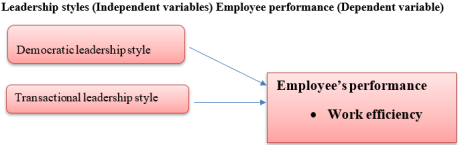
Among the various leadership style variables identified in the literature reviewed, the researcher selects democratic leadership style and transactional leadership style are to analyse the effect of leadership style on employee performance of Gibe Didessa Farmers Cooperatives Union. In this study, democratic leadership style and transactional leadership style) were set as independent variables and employee performance (work efficiency) are dependent variable. Accordingly, the researcher would be developed the following conceptual framework and indicated the relationship between the independent and dependent variables.
Figure 1. Conceptual Framework of the study developed by researcher: 2024.
3. Research Methodology
The research design employed for this study was consists of both descriptive and explanatory research designs. For this study, quantitative research approach was employed to analyse inferential statistics to achieve its purpose.
The study is adopting the sampling steps of
| [16] | Malhotra, S., & Peterson, M. ( 2006). Basic Marketing Research A Decision-Making Approach (2nd Ed.). New Jersey: Pearson Education, Inc. manufacturing firm in Nigeria. Research Journal of Finance and Accounting, 8(10), 142-154. |
[16]
these steps are closely interrelated and relevant to all aspects of the research. Those steps are target population, Sampling Unit, sample size, and sampling techniques. The whole set of the universe from which a sample taken is called the population
| [24] | Saunders, M., Lewis, P, & Thornhill, A. (2007). “Research Methods for Business Students”, 4th Edition, Prentice Hall. |
[24]
.
In this study, the researcher would be used probability sampling technique particularly cluster and census-sampling method to select an optimal sample size from the identified target population.
Table 1. Target Population of the Study.
Identified Cooperatives union branches | Population |
Gibe-Didesa-FC union (Nekemte) | 49 |
Gute | 6 |
Diga | 6 |
Anno | 4 |
Ukke karsa | 4 |
Total | 69 |
(Source; Gibe- Didessa FC union report, 2023).
Therefore, the sample size would be, =69.
The researcher would be analysed the study based on the data would be collected from primary sources and as well as Secondary source would integrate. In order to obtain relevant and adequate information the study used primary data which collected through self-administered questionnaires with close ended questionnaires as instruments of data collection, for the investigation of effect of leadership styles on the employees performance of the Gibe-Didesa-Farmers’ Cooperative union and it designing the questionnaire, a five point Likert scale would be employed to provide the extent of the respondent’s feelings or opinions and it carried out using the Statistical Package for Social Science (SPSS) version 25.0. Multiple regression analysis is appropriate for this study because (as describing in the conceptual framework or constructs of the study) this study has two independent variables and one dependent variable.
Therefore, the model that could also applied for this study was as described below:
Multiple Regression model, Y= β0 + β1 X1+ β2 X2+e
Where
Y = employees performance of Gibe-Didesa-Farmers’ Cooperative union
β0 = Constant (value of Y when X1 and, X2,= 0)
Β1=Regression coefficient for Democratic leadership style
X1= Democratic leadership style
B2= Coefficient of regression for Transactional Leadership style
X2= Transactional Leadership style
e = the error
4. Result and Discussion
4.1. Constructs Reliability Issues
Table 2. Collected Data Reliability Test.
Variables | Number of items | Cornbrash’s Alpha reliability test |
Democratic leadership style | 6 | .571 |
Transactional leadership style | 6 | .642 |
Employees performance (work efficiency) | 5 | .583 |
Total | 34 | .880 |
(Source: Researcher’s survey result, 2024)
As the result showed from the
Table 2 above, the Alpha values of all scales could be described as the following and the overall reliability value was 0.880 which is greater than 0.70. Therefore, the reliability of the questionnaire is analysed by Cornbrash’s alpha statistics was reliable.
4.2. Descriptive Statistical Analysis of the Study
According to
| [3] | Alhakimi, W., & Alhariry, K. (2014). Internal Marketing as a Competitive Advantage in Banking Industry. Academic Journal Of Management Sciences. 3(1), 15-22. |
[3]
the Likert scale response has been putted on an interval of mean based on the following formula; Max-Min / n1 which means 5-1 / 5 = 0.80.
Therefore, in the difference of 0.8 the mean value categorized from the lowest up to the highest score. It means that the scores falling between the following ranges can be considered as:
Table 3. Mean interval Respondents Intuition/ opinion.
Mean interval | Respondents Intuition/ opinion |
1. 1.00-1.80 | strongly Disagree (mean Lowest practiced) |
2. 1.81-2.60 | Disagree (mean lowest practiced) |
3. 2.61-3.40 | Neutral (mean averages practiced) |
4. 3.41-4.20 | Agree (mean well practiced) |
5. 4.21-5.0 | strongly Agree (mean very well practiced) |
Table 4. Descriptive Statistics for factor and outcome variables=67.
Democratic leadership style | 3.6642 | .60754 |
Transactional leadership style | 3.8980 | .63296 |
Employees performance | 3.7333 | .67270 |
From the
Table 4 above, the mean value of transactional leadership style and democratic leadership style shows that the attitude of respondents toward the question falls on the mean range of agreement by the approximate value of 3.898 and 3.6642, respectively. Thus it shows that respondents were agreed on the idea requested with respect to each variable, which means the practice of transactional leadership style and democratic leadership style are well practiced in Gibe didesa farmers’ cooperative union (GDFCU).
4.2.1. Employees Performance
Table 5. Mean score and standard deviation values of responses concerning with employees performance=67.
| Mean | Std. Deviation |
I always report my work at in time in the union | 3.66 | 1.109 |
Work efficiency is assessed by my supervisor on daily basis in our cooperatives union | 3.79 | 1.135 |
The efficiency of work evaluation is done quarterly in a year in our cooperatives union | 3.99 | .961 |
It is not necessary to come early at work in our cooperatives union | 3.60 | 1.088 |
work efficiency measures focus on amount of time work in office in the cooperatives union | 3.64 | 1.189 |
Grand mean of employee’s performance (Work efficiency) | 3.733 | 0.672 |
(Source: Researcher’s survey result, 2024)
From the
Table 5 above, regarding to work efficiency, 5 questions were asked the respondents to understand that those questions resulted in employee’s performance.
The overall mean score of employee’s performance was 3.733 with 0.672 standard deviation. It represented that most of the respondents were agreed to be retained and efficient in all parameters of employees’ performance. Therefore, the employee’s performance of the Gibe didesa farmers’ cooperative union (GDFCU) was more practiced in the union in all parameters of employee’s performance.
4.2.2. Descriptive Analysis of the Leadership Style Practices
(i). Analysis of the Democratic Leadership Style
Table 6. Mean score and standard deviation values of responses of Democratic Leadership Style=67.
Descriptive Statistics |
Statements | N | Mean | Std. Deviation |
Staff works best as everyone is involved in taking decisions in the cooperatives union | 67 | 3.91 | 1.069 |
Your manager seeks differing perspectives when solving problems. | 67 | 3.10 | 1.017 |
The director/team leader empower subordinate workers | 67 | 3.54 | 1.159 |
Your director/team leader gets people involvement in decisions | 67 | 3.66 | 1.109 |
Your supervisor provides recognition/rewards when others reach their goals. | 67 | 3.79 | 1.135 |
You are not allowed to make decisions that my supervisor did not approve first. | 67 | 3.99 | .961 |
Grand mean of Democratic leadership style | 67 | 3.664 | 0.607 |
(Source: Researcher’s survey, 2024)
As it is indicated in above
Table 6 above, in order to measure the perception of employees about democratic leadership style six questions were asked to the respondents. Accordingly the overall mean score of democratic leadership style shows that mean values 3.664 and standard deviation 0.607, which means that, most of the respondents were agree to the practice of democratic leadership style, as the rule indicated above by
| [3] | Alhakimi, W., & Alhariry, K. (2014). Internal Marketing as a Competitive Advantage in Banking Industry. Academic Journal Of Management Sciences. 3(1), 15-22. |
[3]
. Therefore, the finding has shown as Gibe didesa farmers’ cooperative union has agreed well practiced the democratic leadership style.
(ii). Analysis of Transactional Leadership Style
Table 7. Mean score and standard deviation values of responses of transactional leadership style.
Descriptive Statistics |
Statement | N | Mean | Std. Deviation |
Your director/team leader provides recognition/rewards when others reach their goals. | 67 | 4.22 | .867 |
Your supervisor clearly clarify the responsibility for achieving targets | 67 | 3.82 | 1.242 |
The employees constantly reminded of what they would receive if they do what is expected. | 67 | 3.82 | .920 |
Your manager make clear what one can expect to receive when performance goals are achieved | 67 | 3.66 | 1.095 |
Your manager provides others with assistance in exchange for their efforts | 67 | 3.90 | 1.032 |
Your manager discuss in specific terms who is responsible for achieving performance targets | 67 | 3.97 | .953 |
Grand mean of Transactional leadership style practice | 67 | 3.898 | .632 |
(Source: Researcher’s survey result, 2024)
The value of overall mean score for transformational leadership style 3.8980 with 0.63296 suggesting that there is good transactional leadership style in the in the Gibe didesa farmers’ cooperative union. Based on statistical analysis of transactional leadership style practice were all variables mean scores are high, which inferred the respondents agreed to the fact that transactional leadership style practice are highly applied in the union.
4.3. Inferential Analysis for Leadership Styles Practices and Employees Performance
In this section, correlation analysis of variables, analytical tests (Multicollinearity test, normality tests, and multi linear regression analysis (model summary, ANOVA and coefficients) would be stated and interpreted by using SPSS version 25 software.
4.3.1. Relationship Between Leadership Styles Practices and Employees Performance in Gibe Didesa Farmers’ Cooperative Union
Table 8. Test of Association of Variables (Correlation Analysis).
Correlations | Employees Performance |
Democratic leadership style (DLS) | Pearson Correlation | .847** |
| Sig. (2-tailed) | .000 |
Transactional leadership style (TSLS) | | |
| Pearson Correlation | .780** |
| Sig. (2-tailed) | .000 |
**. Correlation is significant at the 0.01 level (2-tailed). (Source: Researcher’s survey result, 2024) |
The following Correlation Matrix among Leadership Styles Practices and Employees Performance are based on range of values.
Range of value for Pearson’s coefficient (r) Level of Association/relationship r = 0.10 to 0.29 or r = -0.10 to -0.29 Small r = 0.30 to 0.49 or r = -0.30 to -0.49 Medium r = 0.50 to 1.00 or r = -0.50 to -1.00 Large |
As the correlation matrix above showed the correlation coefficient values of the Union performance among leadership styles practices (democratic leadership style, transactional leadership style were. 847,.780 respectively. Their significant level is (.000.000) respectively.
The Pearson correlation test indicated that there is strong positive relationship between democratic leadership style (DLS) and employee’s performance (work efficiency) with a Pearson correlation coefficient of 0.847 with (p<0.001). This significance tells that there is genuine relationship between democratic leadership style and employee’s performance of the cooperative union, followed by transactional leadership style (TSLS), the study showed that there is strong positive relationship between employee’s performance (work efficiency) with a Pearson correlation coefficient of 0.780 at (p<0.001). This significance tells that there is good relationship between transactional leadership style and employee’s performance of the union.
Table 9. Collinearity Statistics.
Coefficientsa |
Model | Collinearity | Statistics |
Tolerance | VIF |
1 | Democratic leadership style | .242 | 4.139 |
Transactional leadership style | .159 | 6.285 |
a. Dependent Variable: Work Efficiency |
(Source: own survey result, 2024)
Accordingly, by using the IBM SPSS Regression outputs, the researcher evaluated the multiple regression models on the next sections.
ii) Model Summary
Table 10. Model Summary of Regression Analysis.
Model Summaryb |
Model | R | R Square | Adjusted R Square |
1 | .907a | .822 | .807 |
a. Predictors: (Constant), Transactional leadership style and Democratic leadership style |
b. Dependent Variable: Work Efficiency |
(Source: Own Survey, 2024)
4.3.2. ANOVA Test
Table 11. ANOVA Model Fit.
ANOVAa |
Model | Sum of Squares | Df | Mean Square | F | Sig. |
1 | Regression | 24.543 | 5 | 4.909 | 56.241 | .000b |
Residual | 5.324 | 61 | .087 | | |
Total | 29.867 | 66 | | | |
a. Dependent Variable: Employee Performance |
b. Predictors: (Constant), Transactional leadership style and Democratic leadership style (Source: Research Survey result, 2024) |
Standardized regression coefficients are useful when you want to compare the effect that different predictor variables have on a response variable. Since each variable is standardized, you’re able to see which variable has the greatest
effect on the response variable
| [30] | Zach, B. (2020). Standardized vs. Unstandardized Regression Coefficients. |
[30]
.
Table 12. Summary of Coefficients of Independent Variables.
Coefficientsa |
Model | Unstandardized Coefficients | Standardized Coefficients | t | Sig. |
B | Std. Error | Beta |
1 | (Constant) | .714 | .261 | | 2.738 | .008 |
| Democratic leadership style | .480 | .122 | .434 | 3.943 | .000 |
Transactional leadership style | .413 | .144 | .389 | 2.871 | .006 |
a. Dependent Variable: Employee Performance |
(Source: research Survey result, 2024)
Unstandardized regression coefficients are useful when you want to interpret the effect that a one-unit change on a predictor variable has on a response variable without comparing in terms of effect on the dependent variable
| [30] | Zach, B. (2020). Standardized vs. Unstandardized Regression Coefficients. |
[30]
.
WE. = 0+ DLSX1 TSLS X2+ e
5. Summary of Major Finding, Conclusions and Recommendations
5.1. Summary of Major Finings
Data for the study was obtained through distribution of questionnaires to a pre-determined sample of employees in Gibe Didesa farmers’ cooperative union. From the total distributed study questionnaire, 97% were returned.
In reference to the results from the conducted descriptive analysis showed that, the overall mean score of employee’s performance was 3.7333 with 0.67270 with standard deviation. The finding of the study revealed that, the employee performance of the Gibe didesa farmers’ cooperative union (GDFCU) was more practiced in all parameters of employees’ performance. Hence, the study’s first research question which says, “What is the current levels employee’s performance of the GDFCU looks like, would be answered by this analysis.
Consequently, the descriptive analysis of this study revealed that has the highest mean value of transactional leadership style, employees Performance, and democratic leadership style shows that the attitude of respondents toward the question falls on the mean range of agreement by the approximate value of 3.898, 3.733 and 3.664, respectively. Thus it shows that respondents were agreed on the idea requested with respect to each variable.
In this study, regarding analytical tests the study used Multicollinearity test and normality tests). Regarding Multicollinearity test, the result of VIF was below 10 and the tolerance statistics was more than 0.1 (10%). The finding showed that, there is no Multicollinearity problem in the regression model used for this study among the predictors.
The results of the regression analysis showed that R=0.907 and R2=0.822 indicated that there is a strong linear correlation between leadership styles practices and the employee performance of GDFCU. Therefore, the result of the analysis revealed that 82.2% variability dependent variable (employee performance) explained by independent variables (leadership style practices). The findings from ANOVA (F-Test) clearly shown that multiple regression model used in this study is statistically significant in explaining the relationship between the independent variables and dependent variable meaning that it is a suitable prediction model for explaining leadership styles practices and employee performance.
On the subject of standardized Beta Coefficients of this study presented that, the highest effect was democratic leadership style has a high positive effect with t-value of 3.943 followed by transactional leadership style has positive effect with t-value of 2.871.
5.2. Conclusions
The main objective of the study was to investigate the effect of leadership styles practices on employee performance. Based on the findings, the researcher concludes that GDFCU was good implemented the leadership styles practices (Democratic and Transactional leadership styles). This is supported by the results from the conducted descriptive analysis that showed, the employee performance of the Gibe didesa farmers’ cooperative union was more practiced in all parameters of employees’ performance.
The findings from the Pearson correlation analysis results revealed that there is a positive and significant correlation between the aggregated leadership styles of (Democratic and Transactional leadership styles and employee performance of Gibe didesa farmers’ cooperative union. Accordingly, the multiple regression analysis result of this study demonstrated that, some dimension of leadership styles Practices) have a strong positive and statistically significant effect on employee’s performance of the GDFC. From the model summary of multiple regressions, the result showed that, the designated the leadership styles practices of (Democratic and Transactional leadership styles) were highly influences on employee’s performance of Gibe didesa farmers’ cooperative union.
5.3. Recommendations
Based on the findings and the conclusions reached, Gibe didesa farmers’ cooperative union is undertaking well implementing leadership styles practices effectively, and efficiently on employee performance. Therefore, the following recommendations were made based on the above findings of the study. From the investigative response of questioners concerning to democratic leadership style the researcher has recommend Gibe didesa farmers’ cooperative union (GDFCU) to give serious attention on each, your manager seeks differing perspectives when solving problems.
Accordingly, an adopting effective practice of transactional leadership style is significantly and positively affecting employee performance of the union. Hence, the researcher recommends that Gibe didesa farmers’ cooperative union has continue to the practice of transactional leadership style practices.
Moreover, the study has identified relative effects of leadership style practices on employee performance based on regression analysis, democratic leadership style and transactional leadership style practice has the strong, significant and positive effect on employee performance of Gibe didesa farmers’ cooperative union in line with work efficiency. Finally, the researcher recommends that Gibe didesa farmers’ cooperative union has continue to the practice of all parameters of employee’s performance (work efficiency) practices.
5.4. Limitations and Suggestions for Future Research
The study depicted the extent of adopting of leadership style practices in Gibe didesa farmers’ cooperative union and how it affects the employee performance of the union. This, study delimited to effect of leadership style on employee’s performance of Gibe-Didesa Farmers’ Cooperative union. However, the findings were only relied on data provided by the case union employees those were located in Gibe didesa farmers’ cooperative union in nekemte and the branch of Gibe didesa farmers’ cooperative union. The concept of leadership style is so broad and has so many dimensions, it is almost impossible to address all of these dimensions in a single study. Therefore, future researchers can incorporate other leadership style practices variables such as participative leadership style, charismatic leadership style and servant leadership style focus on other factors that may affect employee performance dimension team work, quality of work, meeting deadlines, employee loyalty, punctuality.
Abbreviations
GDFCU | Gibe Didessa Farmers’ Cooperative Union |
SPSS | Statistical Package for Social Science |
TSLS | Transactional Leadership Style |
DLS | Democratic Leadership Style |
Author Contributions
Jabessa Tesfa Deressa is the sole author. The author read and approved the final manuscript.
Conflicts of Interest
The author has no conflicts of interest.
References
| [1] |
Abraham, M. B., Jones, T. W., Naranjo, D., Karges, B., Oduwole, A., Tauschmann, M., & Maahs, D. M. (2018). ISPAD Clinical Practice Consensus Guidelines 2018: Assessment and management of hypoglycemia in children and adolescents with diabetes. Pediatric diabetes, 19, 178-192. Adil, M. S. (2014). Impact of leader’s change-promoting behavior on readiness for change: A mediating role of organizational culture. Journal of Management Sciences, 1(2).
|
| [2] |
Al Khajeh, E. H. (2018). Impact of leadership styles on organizational performance’s Journal of Human Resources Management Research, 2018(2018), 1-10.
|
| [3] |
Alhakimi, W., & Alhariry, K. (2014). Internal Marketing as a Competitive Advantage in Banking Industry. Academic Journal Of Management Sciences. 3(1), 15-22.
|
| [4] |
Al-Yami, M., Galdas, P., & Watson, R. (2018). Leadership style and organizational commitment among nursing staff in Saudi Arabia. Journal of Nursing Management, 26(5), 531 -539.
|
| [5] |
Aqqad, N., Obeidat, B., Tarhini, A., & Masa'deh, R. E.(2019). The relationship among emotional intelligence, conflict management styles, and job performance in Jordanian banks. International Journal of Human Resources Development and Management, 19(3), 225-265.
|
| [6] |
Ashenafi et al (2020) “Effects of leadership style on employee performance at Hawassa University”.
|
| [7] |
Atatsi, E. A., Stoffers, J., & Kil, A. (2019). Factors affecting employee performance: a systematic literature review. Journal of Advances in Management Research, 16(3), 329-351.
|
| [8] |
Conger, J. and Kanungo, R. (2018). Charismatic Leadership in Organizations. (Eds), R. N. Kanungo, Thousand Oaks. CA: Sage Publications.
|
| [9] |
Doorasamy, M. (2016). Using DuPont analysis to assess the financial performance of the top 3 JSE listed companies in the food industry. Investment Management and Financial Innovations, 13(2), 29-44. Effort and job performance: The influence of power distance. Journal of Personal.
|
| [10] |
Eman et al (2022) the impact of leadership style on employee performance in the context of Elfora Agro plc. Employee performance. Journal of Advancements in Information Technology, 20, 198.
|
| [11] |
Indrastuti, D. K. (2021). Faktor-Faktor yang Memengaruhi Nilai Perusahaan Sektor Manufaktur. E-Jurnal Akuntansi TSM, 1(1), 117-126.
|
| [12] |
Iqbal, N., Anwar, S. &Haider, N. (2015). Effect of Leadership Style on Employee Performance. Arabian Journal of Business and Management Review, 5(5): 1-6.
|
| [13] |
Kužnin & Walker et al. (2017). Contemporary leadership challenges in hospitality.
|
| [14] |
Liya et al (2018), Effect of Leadership Style on Employee Performance At wegagen Bank S. C”.
|
| [15] |
Maichan, A. (2017). Factors Affecting Work Efficiency of Employees of Production Line Machinery Installation Industry in Songkhla Province.(Master of Business Administration Thesis), Prince of Songkla University, Thailand.
|
| [16] |
Malhotra, S., & Peterson, M. ( 2006). Basic Marketing Research A Decision-Making Approach (2nd Ed.). New Jersey: Pearson Education, Inc. manufacturing firm in Nigeria. Research Journal of Finance and Accounting, 8(10), 142-154.
|
| [17] |
Mihalciuc, C. (2022) Optimizing the link between management accounting and business management, Ecoforum, Vol 11, No 1(27).
|
| [18] |
Mohammad, A. A., Alshura, M. S., Al-Hawary, S. I. S., Al-Syasneh, M. S., & Alhajri, T. M. (2020). The influence of Internal Marketing Practices on the employees’ intention to leave: A study of the private hospitals in Jordan. International Journal of Advanced Science and Technology, 29(5), 1174–1189.
|
| [19] |
Northouse, P. G. (2014). Introduction to leadership: Concepts and practice.
|
| [20] |
Otieno, B. N., & Njoroge, J. G. (2019). Effects of leadership styles on employee performance: Case of Technical University of Kenya. International Journal of Education and Research, 7(6), 115-132. Padmanathan, S. R. (2010). Leadership Styles and Employee Engagement.
|
| [21] |
Pallant, J. (2003). A Step By Step Guide to Data Analysis Using SPSS for Windows (Version 10 and 11). Philadelphia: Open University Press.
|
| [22] |
Peck Peterson, S. M., Caniglia, C., Jo Royster, A., Macfarlane, E., Plowman, K., Jo Baird, S., & Wu, N. (2005). Blending functional communication training and choice making to improve task engagement and decrease problem behaviour. Educational Psychology, 25(2-3), 257-274. Plowman, E., & Peterson, C. (1989). Business organization and management. Illinois: Irwin.
|
| [23] |
Razak, A., Sarpan, S., & Ramlan, R. (2018). International Review of Management and Marketing Effect of Leadership Style, Motivation and Work Discipline on Employee Performance in PT. ABC Makassar. International Review of Management and Marketing, 8(6), 67–71.
|
| [24] |
Saunders, M., Lewis, P, & Thornhill, A. (2007). “Research Methods for Business Students”, 4th Edition, Prentice Hall.
|
| [25] |
Shahnia, C., Purnamasari, E., Hakim, L., & Endri, E. (2020). Determinant of profitability: Evidence from trading, service and investment companies in Indonesia. Accounting, 6(5), 787-794.
|
| [26] |
Shokory, S. M., Hamid, S. A., Awang, M., & Hudin, N. S. (2019). The Impact of the Leadership of the Head of Department on Administrative Staff’s Performance in Malaysian Premier Education University. International Journal of Academic Research in Business and Social Sciences, 9(3), 27–42.
|
| [27] |
Sofi, M. A., & Devanadhen, D. K. (2015). Impact of leadership styles on organizational performance: An empirical assessment of the banking sector in Jammu and Kashmir. IOSR Journal of Business and Management, 17(8), 31-45.
|
| [28] |
Tsigu, G. T., & Rao, D. P. (2015). Leadership styles: their impact on job outcomes in Ethiopian banking industry. ZENITH International Journal of Business Economics & Management Research, 5(2), 41-52.
|
| [29] |
Xie, Y., Xue, W., Li, L., Wang, A., Chen, Y., Zheng, Q., & Li, X. (2018). Leadership style and innovation atmosphere in enterprises: An empirical study. Technological Forecasting and Social Change, 135, 257-265.
|
| [30] |
Zach, B. (2020). Standardized vs. Unstandardized Regression Coefficients.
|
Cite This Article
-
ACS Style
Deressa, J. T. Effect of Leadership Styles on Employees Performance, the Case of Gibe Didesa Farmers’ Cooperative Union. J. Hum. Resour. Manag. 2026, 14(1), 22-32. doi: 10.11648/j.jhrm.20261401.13
 Copy
|
Copy
|
 Download
-
@article{10.11648/j.jhrm.20261401.13,
  author = {Jabessa Tesfa Deressa},
  title = {Effect of Leadership Styles on Employees Performance, the Case of Gibe Didesa Farmers’ Cooperative Union},
  journal = {Journal of Human Resource Management},
  volume = {14},
  number = {1},
  pages = {22-32},
  doi = {10.11648/j.jhrm.20261401.13},
  url = {https://doi.org/10.11648/j.jhrm.20261401.13},
  eprint = {https://article.sciencepublishinggroup.com/pdf/10.11648.j.jhrm.20261401.13},
  abstract = {The main objective of this study was to investigate the effect of leadership styles on employees’ performance of Gibe Didesa Farmers’ Cooperative Union. The Democratic and Transactional leadership styles were the dimensions of leadership styles practices that were investigated in this study. Work efficiency served as the performance metric for the Union employees. The study employed a quantitative research approach to examine the effects of leadership styles practices and employees’ performance of GDFCU. Descriptive and explanatory research design employed for the study. Probability sampling technique particularly cluster and census sampling method were used to enables the researcher to use his discretion in selected samples all the target population. Using 37 questionnaires items, the primary source of data was collected from 66 employees out of 69 employees. A questionnaire with a 5-point Likert scale was used together the data, and SPSS Version 25 was used to analyze the results. The findings the study revealed that styles democratic leadership styles and transactional leadership play significant positive on employee’s performance. Hence, 82.2% the variability of employee’s performance in this study explained by leadership styles practices. Based on the findings, different leadership styles had different effect on employee’s performance. In order to improve employee’s performance Gibe Didesa Farmers’ Cooperative Union to give serious attention on each democratic leadership style items, your manager seeks differing perspectives when solving in order to improve employee’s performance.},
 year = {2026}
}
Copy
|
Download
-
TY  - JOUR
T1  - Effect of Leadership Styles on Employees Performance, the Case of Gibe Didesa Farmers’ Cooperative Union
AU  - Jabessa Tesfa Deressa
Y1  - 2026/01/20
PY  - 2026
N1  - https://doi.org/10.11648/j.jhrm.20261401.13
DO  - 10.11648/j.jhrm.20261401.13
T2  - Journal of Human Resource Management
JF  - Journal of Human Resource Management
JO  - Journal of Human Resource Management
SP  - 22
EP  - 32
PB  - Science Publishing Group
SN  - 2331-0715
UR  - https://doi.org/10.11648/j.jhrm.20261401.13
AB  - The main objective of this study was to investigate the effect of leadership styles on employees’ performance of Gibe Didesa Farmers’ Cooperative Union. The Democratic and Transactional leadership styles were the dimensions of leadership styles practices that were investigated in this study. Work efficiency served as the performance metric for the Union employees. The study employed a quantitative research approach to examine the effects of leadership styles practices and employees’ performance of GDFCU. Descriptive and explanatory research design employed for the study. Probability sampling technique particularly cluster and census sampling method were used to enables the researcher to use his discretion in selected samples all the target population. Using 37 questionnaires items, the primary source of data was collected from 66 employees out of 69 employees. A questionnaire with a 5-point Likert scale was used together the data, and SPSS Version 25 was used to analyze the results. The findings the study revealed that styles democratic leadership styles and transactional leadership play significant positive on employee’s performance. Hence, 82.2% the variability of employee’s performance in this study explained by leadership styles practices. Based on the findings, different leadership styles had different effect on employee’s performance. In order to improve employee’s performance Gibe Didesa Farmers’ Cooperative Union to give serious attention on each democratic leadership style items, your manager seeks differing perspectives when solving in order to improve employee’s performance.
VL  - 14
IS  - 1
ER  -
Copy
|
Download




 Share This Article
 Twitter
 Linked In
 Facebook